Firebase / GCP
Syncing what comes after provisioning — Cloudflare DNS, Logto, cert-gated proxy, env bundles
The design of a CI pipeline that keeps DNS, auth, delivery certificates, and env values — everything left over after config-driven GCP / Firebase provisioning — following the same source of truth.
In Provisioning GCP / Firebase environments from a single settings.yml, I covered getting GCP projects and the Firebase platform generated automatically from a settings file. But that’s not the end. Add one environment and a chain of chores appears outside the foundation:
- Add DNS records in Cloudflare pointing at the Firebase custom domain
- Once delivery is stable, turn the proxy on to get CDN / WAF
- Set up Logto applications / API resources / roles for the operator console
- Collect each app’s env values, encrypt them, and make them referenceable at deploy time
These live in a different layer from provisioning, but left alone they regress into “manual work per environment.” So I built Platform Sync — a mechanism that keeps them following the same source of truth as the foundation.
The big picture
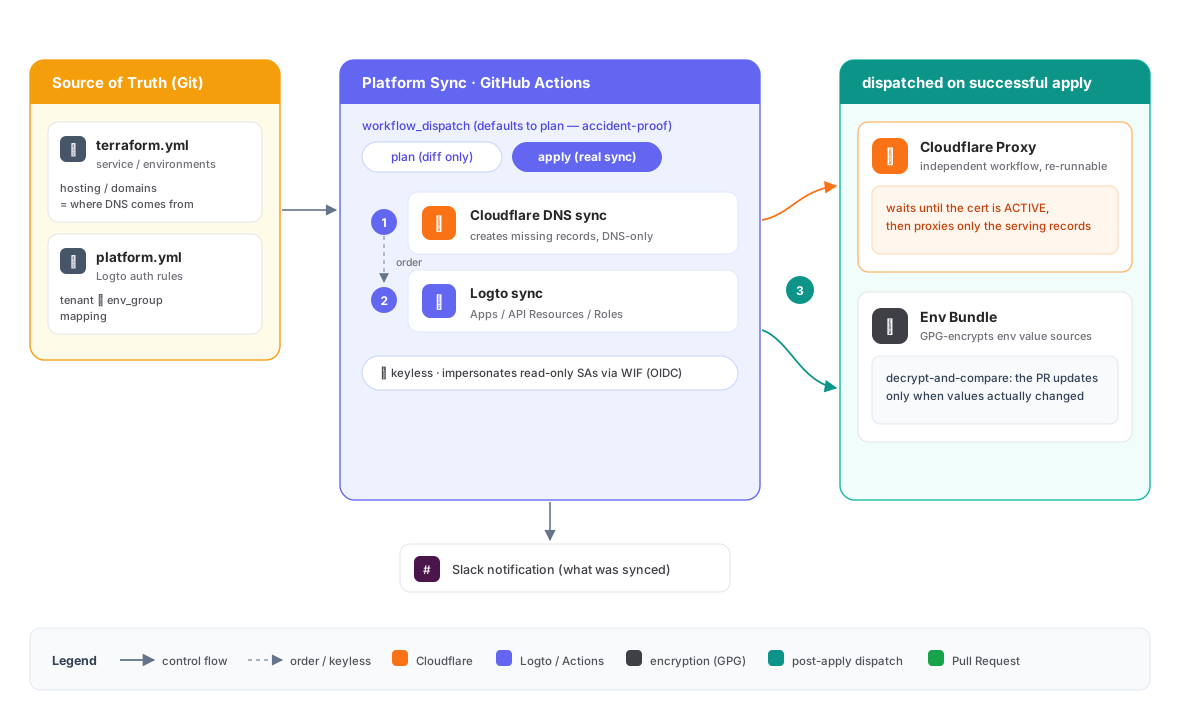 Config (Git) as SoT, chaining Cloudflare DNS → Logto → proxy → env bundle through a series of dispatches.
There are two SoT files. terraform.yml holds service / environments / hosting (i.e. where domains and DNS come from); platform.yml holds Logto’s auth rules and the tenant ⇄ env-group mapping. Platform Sync itself fires manually via workflow_dispatch, defaulting to plan (diff display only). To prevent accidents, the writing mode apply only runs when explicitly selected.
# platform.yml (excerpt, abstracted)
tenants:
  - key: my-service-non-production
    env_groups: [dev, stg]      # the group of envs this tenant is responsible for
    roles:
      - { name: admin, scopes: [secrets:read, secrets:write] }
      - { name: developer, scopes: [secrets:read] }
Processing runs Cloudflare DNS → Logto, in that order. Logto’s redirectUri depends on the domain (= DNS / hosting), so apply runs Cloudflare first. And only when apply succeeds are the two follow-up workflows (Cloudflare Proxy / Env Bundle) dispatched. All authentication is keyless: each environment’s read-only service account is impersonated through Workload Identity Federation (OIDC). No long-lived credentials anywhere.
The default is “never delete”
plan and apply share the same diff computation, with the mode toggling display-only versus real writes. The decision that pays off here: per-environment sync emits no deletions, ever.
Cloudflare’s desired state is derived from the DNS updates Firebase requests. But those requests empty out once the domain goes ACTIVE — they’re satisfied. So naively deleting “records that exist but aren’t in desired” risks taking out records that are serving traffic. Per-env sync therefore only creates what’s missing; deletion is split into a separate reconcile job. Reconcile matches against the env naming convention (<tier>-<number>) and tier constraints, and only records not belonging to defined envs or retained_envs become deletion candidates — the line that avoids false positives on unrelated records like www or api.
Deletion is always dangerous, so it only activates with an explicit allow_delete flag; plan stops at previewing “what would be deleted.”
The hard part: don’t turn the proxy on until the cert exists
The timing of the proxy switch is what this pipeline sweats over most.
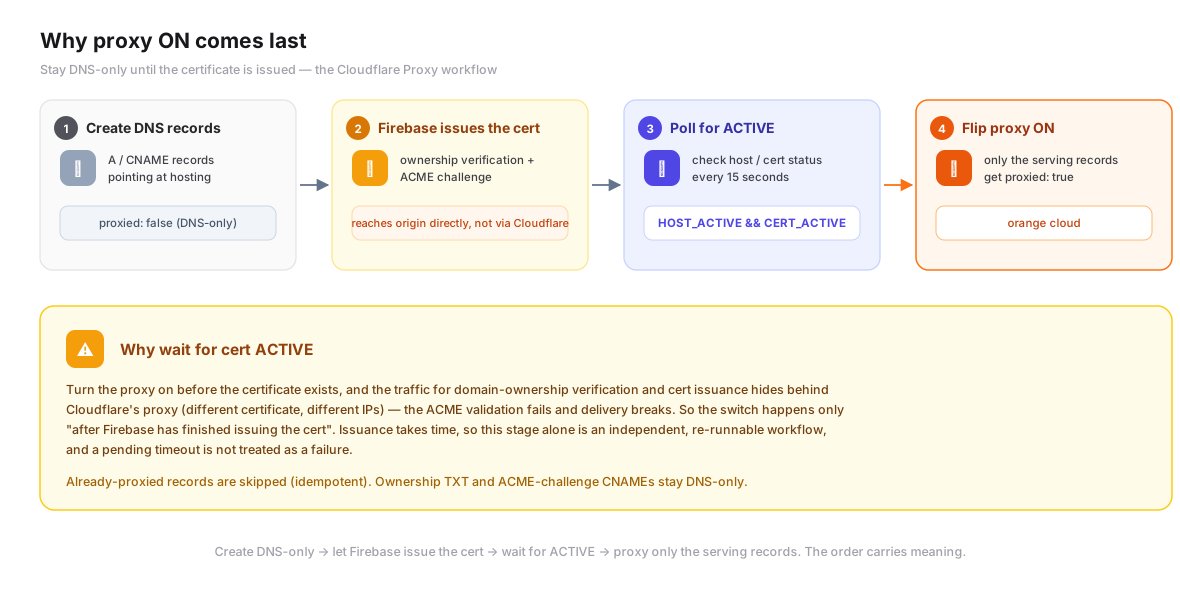 Create DNS-only → let Firebase issue the cert → wait for ACTIVE → proxy only the serving records. The order carries meaning.
DNS records are always created with proxied: false (DNS-only, grey cloud). In that state, Firebase can reach the origin directly for domain-ownership verification and certificate issuance. Turn the proxy on too early and the verification and ACME challenge traffic hides behind Cloudflare’s proxy (different cert, different IPs) — the certificate can’t be issued and delivery breaks.
So the Cloudflare Proxy workflow polls the Firebase custom domain’s host / cert status at 15-second intervals. Once it reaches HOST_ACTIVE && CERT_ACTIVE (treating CERT_PROPAGATING during distribution as “issued = reachable”), it flips only the serving records that point at the hostname itself to proxied: true. Ownership TXT records and ACME-challenge CNAMEs stay DNS-only.
Certificate issuance takes time. That’s why this stage isn’t embedded in the main workflow but split into an independent workflow that can be re-run later. Timing out while pending isn’t a failure; run it again and it resumes waiting for ACTIVE. Already-proxied records are skipped, so it’s safe to run any number of times.
Logto: auth config that depends on domains
The Logto side syncs per tenant. It obtains client_credentials for the Management API using an M2M app’s credentials and reuses the token. Three kinds of things are synced:
- API Resources (+ scopes / permissions)
- Roles (+ scope assignments)
- Applications (the SPA for the operator console)
Writes have ordering constraints: assigning scopes to a role requires the resource-side scope ids, so it proceeds API Resources → Roles → Applications.
An application’s redirectUri is assembled from the environment’s domain (https://<domain>/callback, etc.). The point is that target domains are derived from terraform.yml’s hosting definitions, not listed in platform.yml. This is also why apply runs Cloudflare first — without the domain settled, you can’t build the correct redirectUri. Deletion is conservative here too: only applications it manages — names starting with <service>- and ending with -web-system-console — can ever be treated as orphans.
Env bundles and GPG: keep it off argv
Last is how env values are bundled. Per environment, a value source (JSON including the Firebase web app config and Logto app id) is generated, tarred, and encrypted with GPG symmetric encryption into a .tar.gpg. The encrypted bundle is committed; the decrypted plaintext JSON is gitignored. Only “the key itself” lives in CI secrets.
# The passphrase arrives via env var and flows only into fd 3 via process substitution
set -o pipefail
tar cf - "$src" | gpg -c --batch --yes --pinentry-mode loopback \
  --passphrase-fd 3 -o "$out" 3< <(printf %s "$PASSPHRASE")
Unglamorous but important: how the passphrase is passed. Put it on the command line and it’s visible in ps, so instead it’s fed through process substitution into fd 3 and read with --passphrase-fd 3. printf is a bash builtin, so it doesn’t even become a separate process. A path where the passphrase appears neither in argv nor in any other process.
The other trick is the diff. GPG encryption produces different bytes every run, so diffing bundles directly yields changes even when the content is identical — mass-producing meaningless PRs. So the existing bundle is decrypted once and the plaintexts compared; re-encryption happens only when values actually changed (or no bundle exists). PRs force-push to a fixed branch: update the open PR if one exists, create one if not — never duplicating.
Developers hold no secrets
The heart of this setup: a developer can reach deployment without ever holding a dev environment’s env values or the decryption key. Generating the value sources, encrypting with GPG, decrypting at deploy — all of it completes inside CI. The passphrase is held only by CI as a CI secret; the only thing in Git is the encrypted .tar.gpg. The plaintext value source appears only on CI runners during generation and is gitignored, so it’s never committed.
In other words, what developers touch day-to-day is the config (terraform.yml / platform.yml) and the finished encrypted bundles. “No dev secrets on anyone’s laptop” is guaranteed by the mechanism, not by operating rules or review diligence. Since no distribution channel for secrets exists, the accidents themselves — leaks during distribution, stale .env files quietly diverging across machines — can’t happen. It’s the same idea as going keyless (WIF) for cloud credentials, extended to application env values.
Decisions that pay off
Keyless doubles as an existence check. When cleaning up bundles for retired environments, “does that GCP project still exist?” is answered by attempting to impersonate the read-only SA with access_token and checking success. If the project / SA is gone, impersonation fails — that failure is the “doesn’t exist” signal. (One caveat: without token_format, the auth step merely writes config and always succeeds, so it decides nothing.)
Heavy stages are split into independent workflows. The certificate wait is separated from the main body, and only environments with DNS changes are handed to the follow-ups. Zero changes means the proxy workflow isn’t even started.
What I gave up
The cost is the growing chain of workflow dispatches. The apply → proxy / env-bundle branching trades clarity for the chore of tracking “where did it stop.” With Cloudflare, Logto, Firebase, and GitHub Actions all involved, failure triage is harder than in a single system.
Even so, collapsing the cost of one more environment into “add a few lines of config and run apply” is worth a lot. Last time, the foundation was generated from config. This time, everything outside it — DNS, auth, delivery, env — follows the same config. Push infrastructure all the way into “something you write and generate,” and the operational concern shifts from individual environments to the machinery that generates and syncs them.
Comments
Loading comments…
If the widget does not load, open on GitHub ↗